What Canada Should Learn From 20 Years of Airport Privatization
Five lessons, drawn from more than 140 transactions across 39 countries, that should shape the legislation expected later in 2026.

The Spring Economic Update of April 28, 2026 committed the federal government to assessing alternative ownership models for Canadian airports and to introducing legislation later this year. The same file was studied in 2003 (Bill C-27), 2006 (Bill C-20), and 2016 (Credit Suisse review). Three governments walked away. The fourth has decided to act.
The questions Canada is about to ask have answers in the international record. From 1987 to 2025, 39 countries privatized or concessioned airports through more than 140 transactions. Five lessons emerge consistently. Each has named successes and named failures, and each maps to a structural decision the Canadian legislation will make in the next 18 months.
This is what the record shows.

Lesson 1. Consolidate before you transact.
Spain consolidated 46 airports and 2 heliports into AENA in 1991 and waited 24 years to list. The 2015 IPO was oversubscribed several times over. The state retained 51 percent. AENA reported 5,827.8 million euros in consolidated revenue in 2024, EBITDA of 3,510.3 million euros, and a net profit of 1,934 million euros. The share price appreciated approximately 270 percent in the first ten years of trading.
Brazil took the inverse path. Round 1 in 2011 sold three airports under upfront-fee competition with no consolidation framework. Viracopos went into financial restructuring in 2017. Galeao followed in 2020. The Brazilian government studied the failure and rebuilt the auction structure. By Round 7 in 2023, regional blocks had replaced individual asset tenders, and traffic-risk-sharing had replaced upfront-fee optimization. In November 2025, Mexico’s ASUR signed an agreement to acquire Motiva’s airport subsidiary CPC for R$5 billion (US$936 million), with an implied enterprise value of R$13.7 billion (US$2.566 billion), covering 20 airports across Brazil, Ecuador, Costa Rica, and Curacao.
The Canadian implication is direct. Twenty-one airport authorities. Twenty-one balance sheets without share capital. A transaction structure committed before consolidation will produce twenty-one different valuations and the Brazilian Round 1 outcome.
Lesson 2. Draft the regulator before the sale closes.
AENA’s 2015 listing was paired with the Airport Regulation Document framework, known as DORA. DORA I covered 2017-2021. DORA II covers 2022-2026 with a 2.25 billion euro investment cap and frozen tariffs. Aena’s proposal for DORA III (2027-2031) totals approximately 13 billion euros in airport investment. The framework sets tariffs in advance, requires airline consultation, and is overseen by the CNMC, Spain’s competition regulator. Spanish airport fees have stayed within the regulator’s bands for ten years.
Australia took the opposite sequence. Sydney was privatized in 2002, Melbourne, Brisbane, Adelaide, and Perth in earlier transactions. The regulatory framework followed the transactions. The ACCC airport monitoring regime exists in its current form because of the fee trajectory that followed.
The Canadian implication is that the airport authorities, the airlines, and the institutional investors who will bid should be at the table as co-architects of the regulatory document, before the transaction structure is committed. Drafting the regulator concurrently produces the Spanish outcome. Drafting it afterward produces the Australian one.
Lesson 3. Retain the public majority.
The countries that built durable national operators kept majority control. Spain holds 51 percent of AENA. France holds majority control of Aeroports de Paris through the 2006 partial IPO. Mexico mandated equity floors in each of its three regional airport groups in 1998. Argentina kept its concession with a domestic consortium that became Corporacion America.
The United Kingdom in 1987 made the opposite decision. BAA was sold without domestic preference and without retained equity. Heathrow today is owned through FGP Topco by Ardian (22.6 percent), Qatar Investment Authority (20 percent), the Saudi Public Investment Fund (15 percent), Singapore’s GIC (11.2 percent), the Australian Retirement Trust (11.2 percent), China Investment Corporation (10 percent), Ferrovial (5.25 percent), CDPQ (2.65 percent), and the Universities Superannuation Scheme (2.1 percent). Canadian and other foreign pension funds have been paid by Heathrow passengers for two decades.
The Canadian implication is that the federal government has the option to retain the controlling block through the Canada Sovereign Wealth Fund announced in the Spring Economic Update. The Spanish and French records show what 51 percent retention produces over twenty years. The British record shows what zero retention produces.
Lesson 4. Anchor with domestic institutional capital.
Mexico’s 1998 privatization required Mexican equity in each of the three airport groups. GAP, OMA, and ASUR are today three of the largest publicly-listed airport operators in Latin America. ASUR alone reported 71 million passengers in 2024 and signed in November 2025 the agreement to add Brazil, Ecuador, Costa Rica, and Curacao to its existing presence in Mexico, Colombia, and Puerto Rico.
Argentina built its domestic operator the same way. Corporacion America Airports today operates 52 airports across Argentina, Brazil, Uruguay, Ecuador, Armenia, and Italy, with 86.7 million passengers in 2025.
Turkey awarded its first concession to TAV in 1997. TAV operates 15 airports across 8 countries. Aeroports de Paris first acquired a stake in TAV in 2012 and increased it to 46.12 percent in 2017.
India built two domestic operator platforms in parallel. GMR Group runs Delhi Terminal 3, Hyderabad, Goa Mopa, Cebu, and Heraklion in Greece. Adani Airport Holdings runs Mumbai, Lucknow, Ahmedabad, Mangaluru, Jaipur, Guwahati, and Thiruvananthapuram.
The United Kingdom did the opposite. The 1987 BAA sale was an open auction with no domestic preference.
The Canadian implication is that PSP Investments, CDPQ, OMERS, and OTPP are operating-grade airport investors today because they bought airports abroad. OTPP held stakes in Birmingham, Bristol, Brussels, Copenhagen, and London City for nearly 25 years before exiting through transactions completed across 2025 to Macquarie, ParticipatieMaatschappij Vlaanderen, and the Danish state. PSP’s AviAlliance operates Athens, Dusseldorf, Hamburg, San Juan, Aberdeen, Glasgow, and Southampton. AviAlliance acquired AGS Airports from Ferrovial and Macquarie in a transaction announced November 2024 and completed January 2025, with an enterprise value of 1.53 billion pounds. Vantage Airport Group, founded in 1994 as a subsidiary of the Vancouver Airport Authority, operates LaGuardia Terminal B and JFK Terminal 6 under public-private partnership structures.
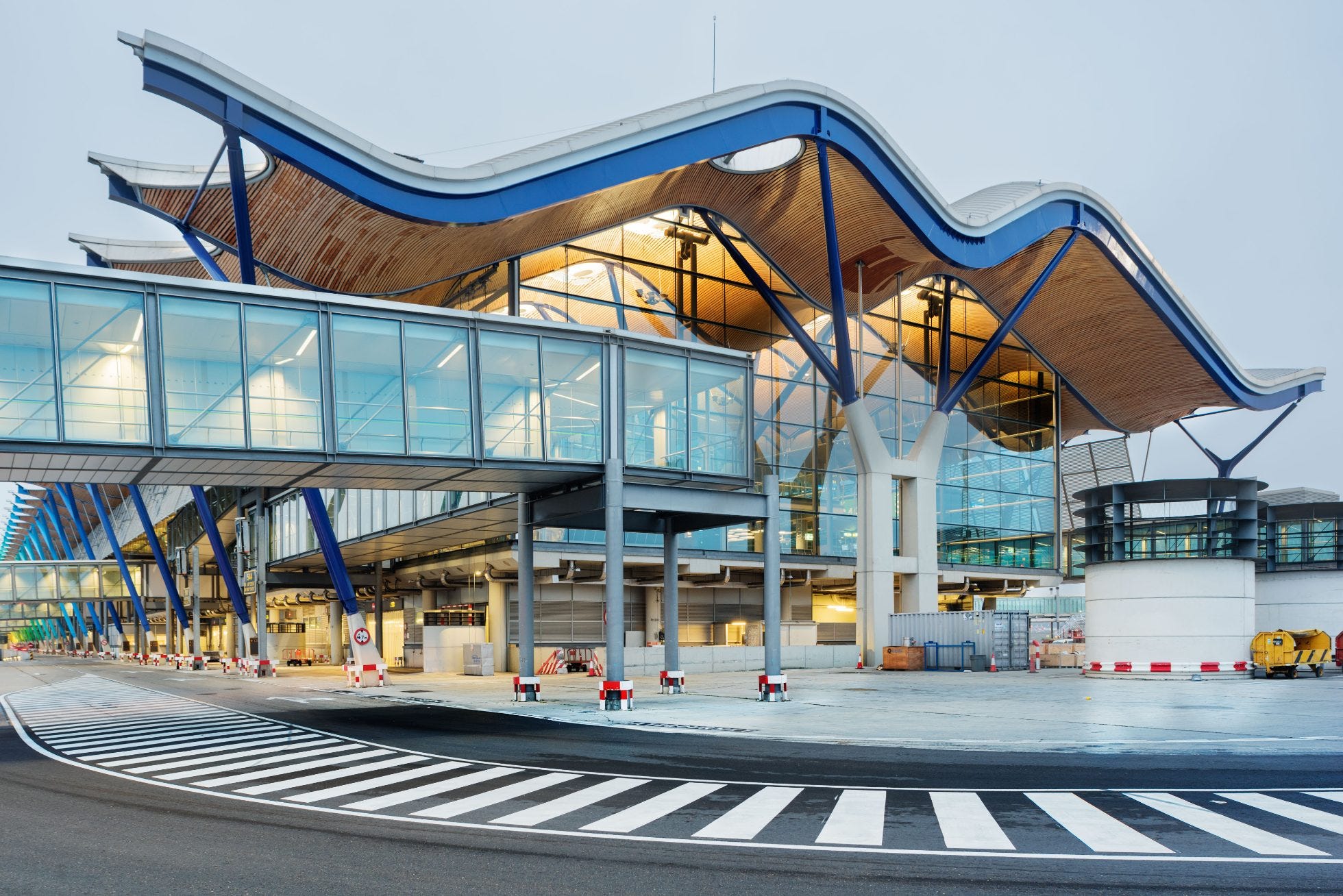
Lesson 5. Asset or tool: the structural choice.
The countries that built national operators treated airports as tools to build platforms. Britain treated Heathrow as an asset to sell.
AENA acquired a 51 percent stake in London Luton Airport in 2013 alongside Ardian. AENA acquired a 51 percent stake in a holding company owning Leeds Bradford Airport and 49 percent of Newcastle Airport in December 2025 for 270 million pounds. AENA’s combined UK portfolio handles approximately 26.5 million passengers annually. AENA Brasil operates 17 airports in Brazil through the ANB and BOAB concession blocks. Aeroports de Paris consolidated TAV in 2017 and operates 26 international airports across the ADP-TAV network. AviAlliance, Canadian-owned through PSP Investments, operates seven international airports following the AGS acquisition. VINCI Airports operates more than 70 airports across 14 countries and recorded 334 million passengers in 2025 with revenue of 4.796 billion euros. Corporacion America Airports operates 52 airports across 6 countries.
The United Kingdom acquired zero international airports through a UK-headquartered operator after 1987. Australia, after more than two decades of airport privatization, has produced no Australian airport operator competing internationally.
The Canadian implication is the most strategic of the five lessons. The legislation can produce a Canadian operator that competes with AENA, Aeroports de Paris, VINCI and TAV for global infrastructure mandates over the next twenty years. Or it can produce a transaction that hands Canadian airport equity to those operators and builds zero Canadian platform.
The structural choice is between treating Pearson, Vancouver, and Montreal as tools to build a Canadian operator, and treating them as assets to sell.
What I will be tracking
The legislation expected later in 2026 will reveal which of these five lessons the government has internalized. Three signals will tell me which it is. First, whether the law provides for the conversion of airport authorities to share-capital entities, the precondition for Lesson 1. Second, whether the regulatory framework is drafted concurrently with the transaction structure, the test for Lesson 2. Third, whether Canadian pension funds are positioned as anchor investors with domestic preference, the test for Lessons 3 and 4. Lesson 5 follows from the first four.
A full policy paper underlies this piece. It runs to 15,000 words across three parts, with 55 numbered references, and develops the six structural options available to Canadian legislators in detail — from the status quo enriched with regulation through to full national consolidation on the AENA model. It includes the data on the 21 Canadian airport authorities, the Maple 8 capital pool, the Vantage and AviAlliance operating histories, the regulatory architecture options, and the legislative sequencing required to deliver each path. The paper is available on request. Subscribers working on this file in government, at airport authorities, or inside institutional investors evaluating the Canadian opportunity should write directly.